Posted: September 12, 2018
| Dimensions |
Designed for Letter Size (8.5" x 11")
|
| Printer compatibility |
Designed to print on all ink-jet and laser printers
|
| Editable |
Acrobat Reader |
| Format |

|
| Platforms |
 
|
| Usage |
Unlimited number of prints
|
| Download time |
Less than 1 minute (approx.)
|
Posted: November 11, 2015
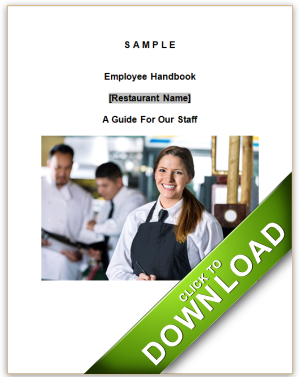
Sample Employee Handbook for the Restaurant Industry
The employee handbook is one of the most important communication tools between a company and its employees. Not only does it set forth your expectations for your employees, but it also describes what they can expect from the company. Regardless of size, all employers should consider creating an employee handbook to make their company's policies accessible to employees. Your employee handbook should be as clear and unambiguous as possible, and written in an understandable language.
Special Note: This sample restaurant handbook is available for general reference purposes only and should be modified to reflect your company's particular needs as well as state-specific laws and requirements that may apply to your business. Please be sure to consult an employment law attorney before using the sample restaurant handbook.*
*These materials are provided for your reference only. Although they have been carefully drafted by our team of attorneys, every company's business and circumstances are different. Although federal laws are uniform, state and local laws vary considerably from one state to another and even from one city to another. The particular circumstances of your company, e.g., union or non-union, number of employees, working in one state versus multiple states, etc. should be addressed by competent employment counsel who knows the details of your business. Please also note since laws can change, the sample handbook may not be in compliance with all rules and regulations. We provide these materials to you as a source of information to guide you in your employment practices and procedures. By accepting and using this handbook or other materials from our site, you acknowledge that you understand and agree that we are not providing you legal, accounting or any other professional service.
Posted: June 24, 2015
SMM Templates
The Summary of Material Modifications (SMM) must be written in a manner calculated to be understood by the average plan participant. There are no other specific formatting requirements under the law.
Download our sample SMM guidelines and templates below:

About the Summary of Material Modifications (SMM)
The summary of material modifications describes material modifications to the plan and changes to information required to be included in the SPD. Material changes that do not result in a reduction in covered services or benefits must be disclosed through an SMM not later than 210 days after the end of the plan year in which the change was adopted (note that timely distribution of an updated SPD may satisfy this requirement).
For purposes of this notice requirement, a material modification includes any modification to the coverage offered under a plan that, independently, or in conjunction with other contemporaneous modifications or changes, would be considered by an average plan participant to be an important change in covered benefits or other terms of coverage under the plan or policy. A material modification could be an enhancement of covered benefits or services or other more generous plan or policy terms. It includes, for example, coverage of previously excluded benefits or reduced cost-sharing.
Material Reduction in Covered Services or Benefits -- Provide Notice Within 60 Days
The administrator of a group health plan is required to provide each participant covered under the plan with a summary of any modification to the plan or change in the information required to be included in the SPD that is a material reduction in covered services or benefits not later than 60 days after the date of adoption of the modification or change (note: that this summary may be provided instead with information about the plan that is furnished at regular intervals of not more than 90 days, if certain requirements are satisfied).
A "material reduction in covered services or benefits" means any modification to the plan or change in the information required to be included in the SPD that, independently or in conjunction with other contemporaneous modifications or changes, would be considered by the average plan participant to be an important reduction in covered services or benefits under the plan. A reduction in covered services or benefits generally would include any plan modification or change that:
- Eliminates benefits payable under the plan;
- Reduces benefits payable under the plan, including a reduction that occurs as a result of a change in formulas, methodologies or schedules that serve as the basis for making benefit determinations;
- Increases premiums, deductibles, coinsurance, co-payments, or other amounts to be paid by a participant or beneficiary;
- Reduces the service area covered by a health maintenance organization; or
- Establishes new conditions or requirements (e.g., pre-authorization requirements) to obtaining services or benefits under the plan
Please Note: The sample SMM templates featured in this section may be used for general reference purposes only. All sample templates should be modified to meet your company’s particular plan design and benefits offered. We strongly recommend consulting a professional group benefits expert for assistance with customizing any templates.
Posted: November 16, 2010
Notices, Requests and Waivers
The day-to-day operation of your company depends heavily on the organization and productivity of your workforce. Whether your company policy requires employees to be present at the office or offers some degree of flextime, the use of standardized forms to handle certain routine matters, such as company parking or employee requests for overtime approval, can help to improve organization and provide documentation of certain work-related issues.
This section provides sample forms related to:
- Company Parking and Carpooling
- Flexible Workplace
- Notices to Employer
- Request Forms
Posted: November 15, 2010
Please Note: The sample forms and policies featured in this section may be used for general reference only. All sample forms and policies should be modified to meet your company’s individual needs and applicable laws. Federal and state laws do change and, as a result, the featured forms and policies may not comply with current requirements. We strongly recommend consulting an employment law attorney or HR specialist for assistance with customizing any forms, policies, or the sample employee handbook. Any links that have been provided as an additional source of forms or guidelines are also for general information purposes and cannot be guaranteed for accuracy or compliance with any particular law or requirement.
Posted: November 15, 2010
Workplace Safety Posters & Signs
The responsibility of each employer is to ensure the safety of all employees in the workplace. Signage is an effective way to alert employees to potential dangers and send a clear message to all that safety is a top priority at your company. Make sure to post signage in highly visible areas and near equipment that may pose a danger to employees. For more information on worker safety, please visit our OSHA section.
Posted: November 15, 2010
Vacation & Time Off Forms
It is not uncommon for employees to request time off pursuant to company policy or employee leave laws. Under certain circumstances, employers may be required by federal or state law to permit an employee to take a leave of absence for a particular time period. For example, the federal Family and Medical Leave Act (FMLA) provides certain employees with up to 12 weeks of unpaid, job-protected leave per year for certain family and medical events.
This section provides the following forms related to employee time off:
Employer Support Tools
Posted: November 15, 2010
Sexual Harassment Policies and Forms
Regardless of the size of their company, employers should be prepared to address issues surrounding sexual harassment in the workplace. The Equal Employment Opportunity Commission encourages employers to take steps necessary to prevent sexual harassment from occurring and to clearly communicate to employees that sexual harassment will not be tolerated. Employers can do so by providing sexual harassment training to their employees and by establishing an effective complaint or grievance process and taking immediate and appropriate action when an employee complains.
The following are sample forms related to sexual harassment in the workplace.
Employer Support Tools
Posted: November 15, 2010
Reporting Injuries, Incidents & Illnesses
Employers are required by various federal and state laws to document and report certain injuries and illnesses that occur in the workplace. For example, the federal Occupational Safety and Health Act (OSH Act) requires employers to complete certain forms to record incidents of work-related injuries and illnesses. State workers’ compensation laws also may require employers to report workplace fatalities or other accidents, often within a short time period (e.g., less than one week).
We provide sample forms, reports, and worksheets to document workplace injuries, illnesses, and incidents. Depending on the specific compliance requirements, an employer may need to document particular items, such as the circumstances of the injury or the employees' hours lost due to injury. The sample documents provided in this section include:
Posted: November 15, 2010
Introduction to Termination Forms
Whether an employee is terminated for misconduct or as part of a reduction in force, the employer must carefully execute and document each step in the termination process in case the employer is later called upon to defend its actions. It is also very important to establish specific procedures for how your company will manage issues related to employee discipline and dismissal, including how the company policy will be communicated to employees. Be sure to treat all employees fairly and consistently in accordance with those procedures.
The sample forms related to termination provided in this section cover the following topics:
Employer Support Tools
- Genetic Information Nondiscrimination Act of 2008 (GINA) - This federal act prohibits discrimination in employment based on genetic information.
- Title VII of the Civil Rights Act of 1964 - This federal act prohibits discrimination in employment on the basis of race, color, sex (including pregnancy and certain protections for lesbian, gay, bisexual, and transgender (LGBT) individuals), religion, and national origin. Many states and some local governments have similar laws prohibiting discrimination based on these classifications. State and local statutes may also prohibit discrimination based upon immutable characteristics. State and local statutes may affect employers who are too small to be covered by federal law.
- The Americans with Disabilities Act (ADA) - This federal act prohibits discrimination against persons who are disabled, so long as the person is qualified to perform the job at issue. Employers are obligated to provide “reasonable accommodation” to disabled employees so long as the accommodation does not impose “undue hardship” on the employer.
- The Age Discrimination in Employment Act (ADEA) - This federal act prohibits discrimination against individuals age 40 and older on the basis of their age. The Older Workers Benefit Protection Act (OWBPA), which is part of the ADEA, also addresses pension benefits for older employees and prescribes a strict mechanism through which employees may waive ADEA claims. Many states have similar statutes. At least one state protects all employees against age discrimination, including younger employees.
- The Uniformed Services Employment and Reemployment Rights Act (USERRA) - This federal act prohibits discrimination against a person on the basis of past military service, current military obligations, or intent to serve. Many states also provide job-protected military leave.
Posted: November 15, 2010
Personnel Information Forms
Maintaining individual records for each of your employees is a good way to keep track of information concerning the employee’s relationship with your company and, in certain instances, may be required. It is important to consult both federal and state law when building your employee personnel files to be sure that you comply with any applicable requirements as to what information should be collected, what your company may or may not do with that information, and how long records should be kept.
The following categories contain sample forms related to personnel files that are designed to assist you in organizing and maintaining your employee records:
Posted: November 15, 2010
Performance Review Forms
The sample performance review forms in this section are designed to assist you in this critical task. You should make sure that your review process treats employees equitably and avoid any statements or actions that can be construed as discriminatory.
The sample forms in this section cover the following categories:
- Documentation for Successful Performance Assessments
- Employee Review
- Evaluating Exempt and Non-Exempt Employees
- Performance Review Preparation
- Performance Improvement Plans
Posted: November 15, 2010
Introduction to New Hire and Recruitment Forms
A successful recruiting program is key to attracting and selecting qualified candidates to join your company’s workforce. The process of hiring new employees involves several important steps for the employer, from creating an effective job description and promoting the job opportunity, to developing the interview and candidate evaluation process. Once the right candidate has been selected for the position, there are a number of tasks to accomplish a smooth transition for the employee into the workplace. Employers also need to ensure that they comply with all legal requirements related to recruiting and hiring new employees.
The sample forms and checklists provided in this section cover the following topics related to new employee hiring and recruitment:
- Candidate Evaluation
- Employee Orientation
- Employment Applications
- Interview Questionnaires
- Job Description Outline
- Letters to Applicants
- New Hire Forms
- Personnel Requisition
- Reference Checks
- Skills Analysis
- The Fair Credit Reporting Act
Employer Support Tools
- eLaws – The U.S. Department of Labor’s eLaws (employment laws assistance for workers and small businesses) is designed to help you understand your rights and responsibilities under the laws and regulations administered by the DOL. Each elaws Advisor provides information about a specific law or regulations.
- Employment Law Guide - This Guide describes the statutes and regulations administered by the Department of Labor (DOL) that affect businesses and workers. The Guide includes information to develop wage, benefit, safety and health, and nondiscrimination policies for businesses in general industry.
- Compliance Assistance on selected U.S. Department of Labor (DOL) laws and regulations.
- DOL Wage and Hour Division - The Wage and Hour Division (WHD) is responsible for administering and enforcing some of our nation’s most comprehensive labor laws, including: the minimum wage, overtime, and child labor provisions of the Fair Labor Standards Act (FLSA); and the Family and Medical Leave Act (FMLA).
- Fair Labor Standards Act (FLSA) - The FLSA establishes minimum wage, overtime pay, recordkeeping, and youth employment standards affecting employees in the private sector and in Federal, State, and local governments.
- Exemptions from minimum wage and overtime for executives, administrative, professional, etc.
- FLSA Child Labor Rules Advisor
- YouthRules! Website
Posted: November 15, 2010
I-9 and Related Forms
This section includes the following documents and sample forms for employers:
Employer Support Tools
Posted: November 15, 2010
Government Forms
Department of Labor
Internal Revenue Service
Equal Employment Opportunity
Social Security Forms
Pension Benefit Guaranty Corporation
Posted: November 15, 2010
Retirement Planning Forms
The aim of retirement planning is to save and acquire sufficient (liquid) assets to achieve retirement goals. Retirement planning is an ongoing process that should begin well in advance of the retirement years. Depending on individual factors, such as age, lifestyle, and medical issues, retirement planning may encompass various approaches and strategies.
The following sample forms are designed to assist employees in thinking about and planning for retirement:
Other Employee Support Tools
Posted: November 15, 2010
Compensation & Reimbursement Forms
A thoughtfully planned compensation package can help your company attract the best candidates and retain key employees dedicated to helping your business succeed. In addition to determining pay and benefits, employers need to consider whether workers will be hired as employees or independent contractors, and whether individuals should be classified as exempt or non-exempt workers. Depending on the classification, the employer may be subject to different legal and tax-related obligations, so it is important to make such determinations accurately, with the assistance of knowledgeable employment counsel where necessary.
In this section, we provide a variety of sample forms designed to assist employers in preparing employee compensation packages.
Posted: November 15, 2010
HR Self-Assessments: Checklists & Guides
Taking the time to conduct a comprehensive examination of your company's existing HR processes, documentation, recordkeeping, policies, and guidelines is integral to effective business management. A successful HR self-assessment can help your company discover and eliminate possible risks, and identify potential gaps and areas of weakness. An HR self-assessment can play a key role in helping to prevent employee lawsuits by uncovering issues before they become major problems. Some of the key areas to focus on include employee benefits, recruiting, hiring, compensation, discipline and termination.
The sample forms provided in this section are designed to help your company stay compliant. These forms are for general reference purposes only and should not be construed as legal guidance. It is important to note that if a self-assessment reveals violations that are not subsequently corrected, your company could be at risk for costly fines or lawsuits. For individualized advice and guidance, please consult with an employment law attorney or HR specialist before developing your HR self-assessment.
Posted: November 15, 2010
Sample Forms, Policies & Checklists
The Forms & Policies Section features over 500 sample HR forms, policies and checklists available for downloading, customizing and printing. The range of sample HR forms covers the most important and relevant aspects of managing human resources and the employer/employee relationship including:
Special Note: Federal and state employment laws, requirements, forms and posters can change frequently. In addition, your situation may require application of federal and state laws, as well as coordination with your own company policies. As such, the sample forms featured in the Forms & Policies sections are for general reference use only and should not be used without first consulting an employment law attorney or HR consultant. Also, please be sure to review your state's requirements in the State Laws section as well the posters required by your state.
Additional Online Forms and Posters Library
The following is a listing of online resources for a broad range of government-required forms and posters.
Posted: October 28, 2010
| Dimensions |
Designed for Letter Size (8.5" x 11")
|
| Printer compatibility |
Designed to print on all ink-jet and laser printers
|
| Editable |
MS Word 97 or later |
| Format |

|
| Platforms |
|
| Usage |
Unlimited number of prints
|
| Download time |
Less than 1 minute (approx.)
|
|
